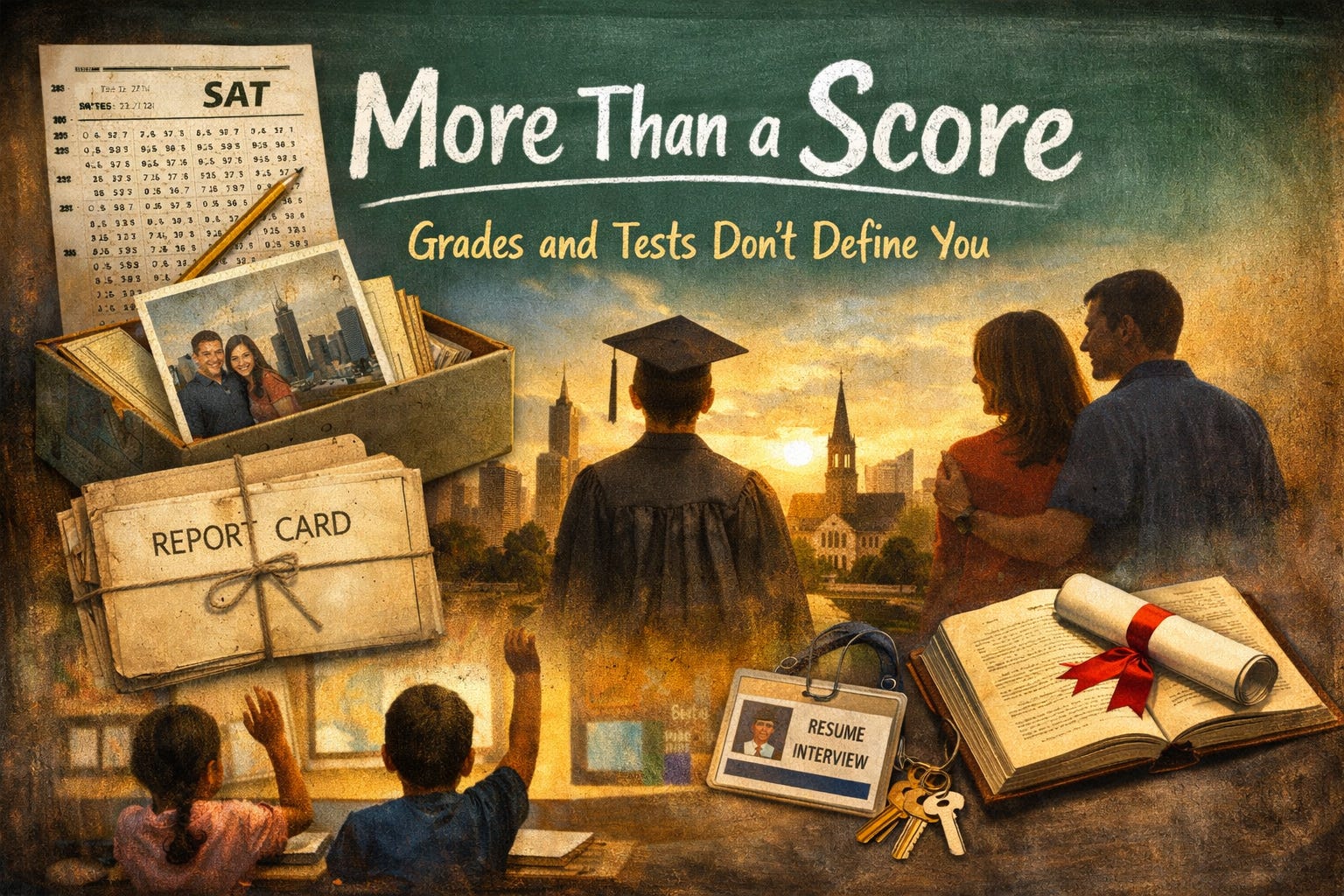
More Than a Score
What MCAS, Grades, and One Shoebox in the Attic Taught me About Identity and Learning

As I’ve written about recently, there is a particular rhythm to schools in the spring. The days get a little longer. Classrooms begin to buzz with thoughts of concerts, field trips, games, graduation, and summer.
And somewhere in the middle of all of that, boxes of testing materials arrive. In Massachusetts, this is MCAS season.
In schools all across the Commonwealth, students are sharpening pencils, opening laptops, taking deep breaths, and sitting down to take a test that carries far more weight in their minds than it should.
Because, despite all of our best intentions, many children have come to believe that a test score tells them who they are.
It does not. And while we are at it, neither do grades.
I know this because I have spent most of my life living the opposite story.
When I was in high school, it took me three tries, and a prep course, to break 1000 on the SAT in 1989, back when there were only two sections.
I was told, rather directly, that with a score like that, I would not get into my first-choice college: Holy Cross.
But I did get in. And that changed my life.
At the College of the Holy Cross, I found a place that believed in something larger than a number. I learned what it meant to live the Jesuit call to be a “man or woman for others.” When I graduated, I joined a small volunteer program teaching in inner-city Chicago. There, in the classroom next door, I met another teacher.
This June, we will celebrate our 22nd wedding anniversary.
All because someone was wrong when they told me what my SAT score meant. Or perhaps more accurately: they misunderstood what a test score is.
A standardized test can tell us some things.
It can tell us how a student performed on a particular set of skills, on a particular day, under a particular set of conditions.
It can sometimes point us toward gaps in learning. It can help schools see patterns, allocate resources, or ask important questions.
But it cannot measure curiosity. It cannot measure resilience. It cannot measure kindness, creativity, courage, humor, leadership, empathy, determination, or heart.
It cannot tell us who will become a beloved teacher, a brilliant nurse, a compassionate doctor, an entrepreneur, a carpenter, a coach, a mechanic, an artist, or a parent.
And it certainly cannot tell us who will fall in love, build a life, change the world around them, or become the kind of person others rely on.
The same is true of grades.
There is a shoebox in the attic of the house where I grew up. Inside are the report cards from my elementary, middle, and high school years.
When I taught high school, during the first week of class, I would often ask my students what they thought I earned in the course I was teaching.
After a few minutes, someone would guess an A. Then a B. Then eventually every letter grade, all the way through F.
Then I would lower my voice and say:
“If you really want to know what I got in this class... please ask my mother to open the shoebox in the attic.”
The students would laugh.
But there was a reason I told that story. I wanted them to understand that the grade itself was not the point. The grade may have mattered for a moment.
But the learning mattered far longer.
Years later, no one asks what grade you got in tenth-grade biology or eleventh-grade English.
They ask whether you can think.
Whether you can communicate.
Whether you can solve problems.
Whether you can work with other people.
Whether you are kind.
Whether you show up.
I have been hiring people since I became a department head in 2003. I can tell you honestly: not once — not once — have I chosen the right person for a position because of a grade on a transcript.
I have hired people because they care. Because they connect with others.
Because they are thoughtful, resilient, funny, trustworthy, hard-working, compassionate, or willing to keep learning.
The qualities that matter most rarely fit neatly into a letter grade or a scaled score.
And yet we continue to send children the message that the numbers define them.
Get good grades in middle school so you can get into the “right” classes in high school.
Get good grades in high school so you can get into the “right” college.
Get good grades in college so you can get the “right” job.
But eventually, somewhere along the way, we have to help young people move from performing for someone else to learning for themselves.
There must be room for agency. There must be room for choice. There must be room for learning simply because something is interesting, meaningful, beautiful, useful, or worth understanding.
The truth is that as I continued my own education, my grades got better and better.
Not because I suddenly became smarter. But because I was choosing it.
I was choosing to learn. I was choosing to grow. I was choosing the work.
In K–12 education, however, there are not always many choices. Students move through required courses, state standards, schedules, assessments, and expectations that are largely set for them.
That is part of the work of public education. Work I am very proud to be a part of.
But perhaps part of our responsibility as educators, parents, and school leaders is to make sure that while we ask students to take the test, we never allow them to believe that they are the test. To make sure that while we issue report cards, we never reduce a child to the report card. To remind them that a score is information, not identity.
A grade is feedback, not destiny. And a difficult moment in school is never the final chapter of someone’s story.
Especially in the spring.
Especially during MCAS season.
Especially for the child sitting in a classroom this week, worried that a number will decide who they are.
It will not. Not even close.